You blast, then you count
Forty people reply "I can work." Nine of them can't. Two already took another shift. You reconcile it by hand, twice, because you don't trust the first pass.
Roster texts your pool one link. Workers tap the role they want. Seats lock the instant they claim. You stop tallying replies and start watching the board fill itself.
Bring your own carrier account — texts billed at cost, never marked up.
The way it works today
Most agencies run event staffing out of a group text and a spreadsheet. It works right up until two orders land on the same Saturday.
Forty people reply "I can work." Nine of them can't. Two already took another shift. You reconcile it by hand, twice, because you don't trust the first pass.
The real number lives in one person's head or a tab they haven't saved. When the client calls Thursday night, you're guessing on the phone.
Mass-text platforms bill per recipient per message. Blast 120 people four times for one event and the fees add up faster than anyone tracks.
How it works
Client, venue, date, dress code, and every role with its own headcount, start time, and pay rate. Ushers at 9:30, setup crew at 6:00, one lead. Roster knows what "filled" means for each line.
Roster picks who to text — by role, reliability, or the whole pool — shows you the cost before you send, and sends one short link. No app for workers to download, no login to remember.
Whoever taps first gets the seat. The rest see the accurate remaining count or land on a waitlist. Two people can't take the same slot, even tapping at the same second.
Your pool
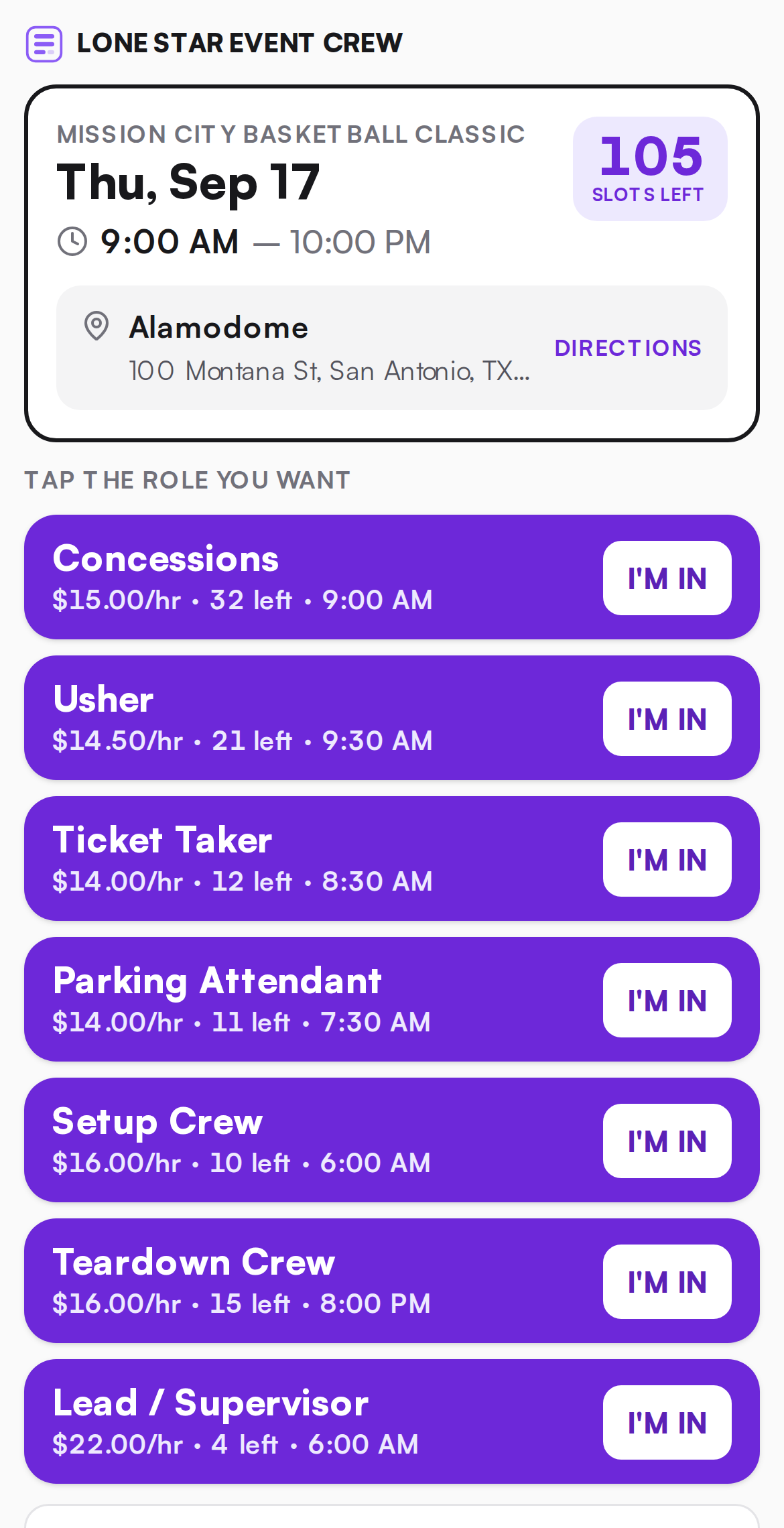
Roster knows who's textable, who's opted out, who shows up, and what each person can actually work — before you pick who to blast.
Recruiting
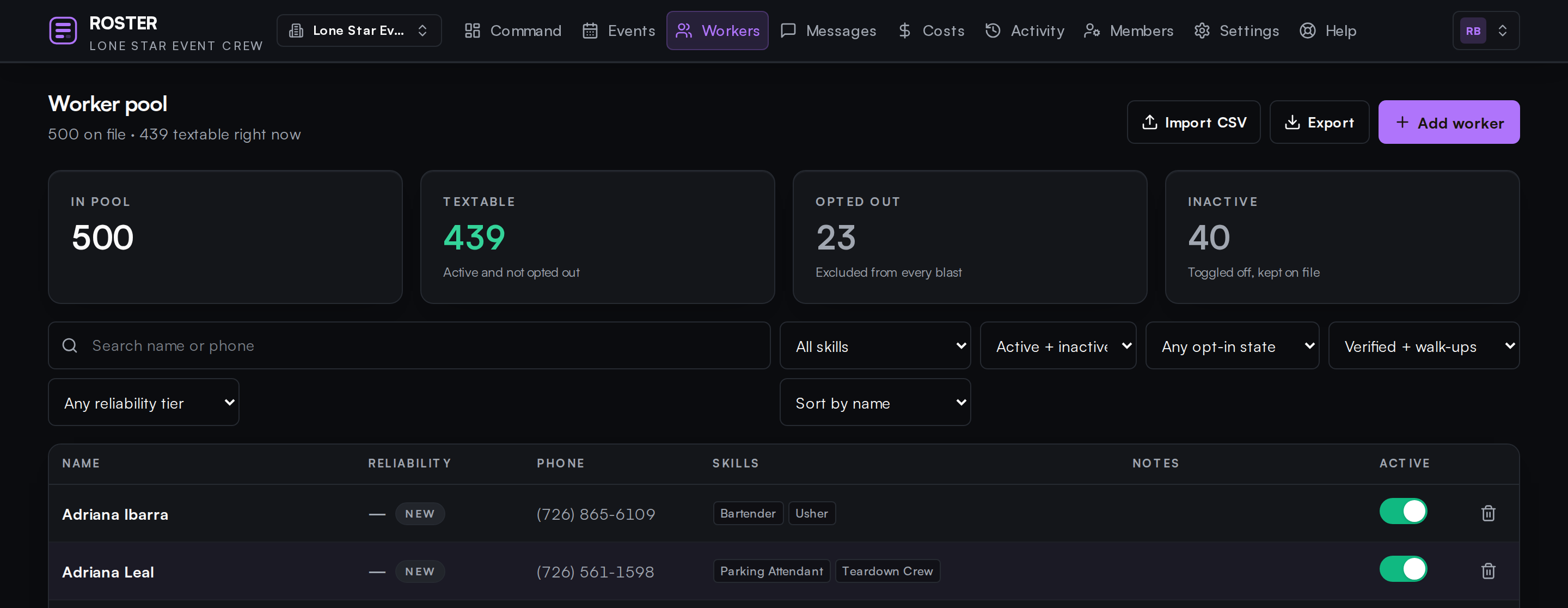
Post one link on Facebook, Instagram, a job ad or a QR code on a flyer. People sign up on their phone in English or Spanish and land in a queue your recruiter approves — never straight onto a live roster.
One page, phone-first, English or Spanish. No app, no account to create.
Name, phone, skills and where they came from, waiting in a queue. A person decides, not the form.
Approved workers are textable on the next blast and start building a reliability record.
Concerts. Games. Festivals. Conventions.
Gates, concessions, ushers, setup, teardown — every role on one board, every seat accounted for before doors open.
What's in it
Built by someone who staffs events, not by someone who read about it.
Separate headcount, start time, and pay rate per role. Fill concessions without touching your leads.
Seats lock atomically. Load-tested with twenty simultaneous taps on five seats — five got in, nobody double-booked.
Someone drops at 6am? Roster offers the seat to the next qualified worker in waves, on a timer, without you awake.
Segment count, recipient count, and dollar estimate on the blast screen. No surprise invoice at month end.
Show, no-show, and late history per worker, weighted so last month counts for more than last spring. Text your dependable people first.
When the event ends, Roster asks. The whole crew is already marked “showed” — tap only the people who didn't, and save. That's what keeps the scores honest.
Overflow claims queue instead of bouncing. Promote in one tap when a seat opens, in the order they raised their hand.
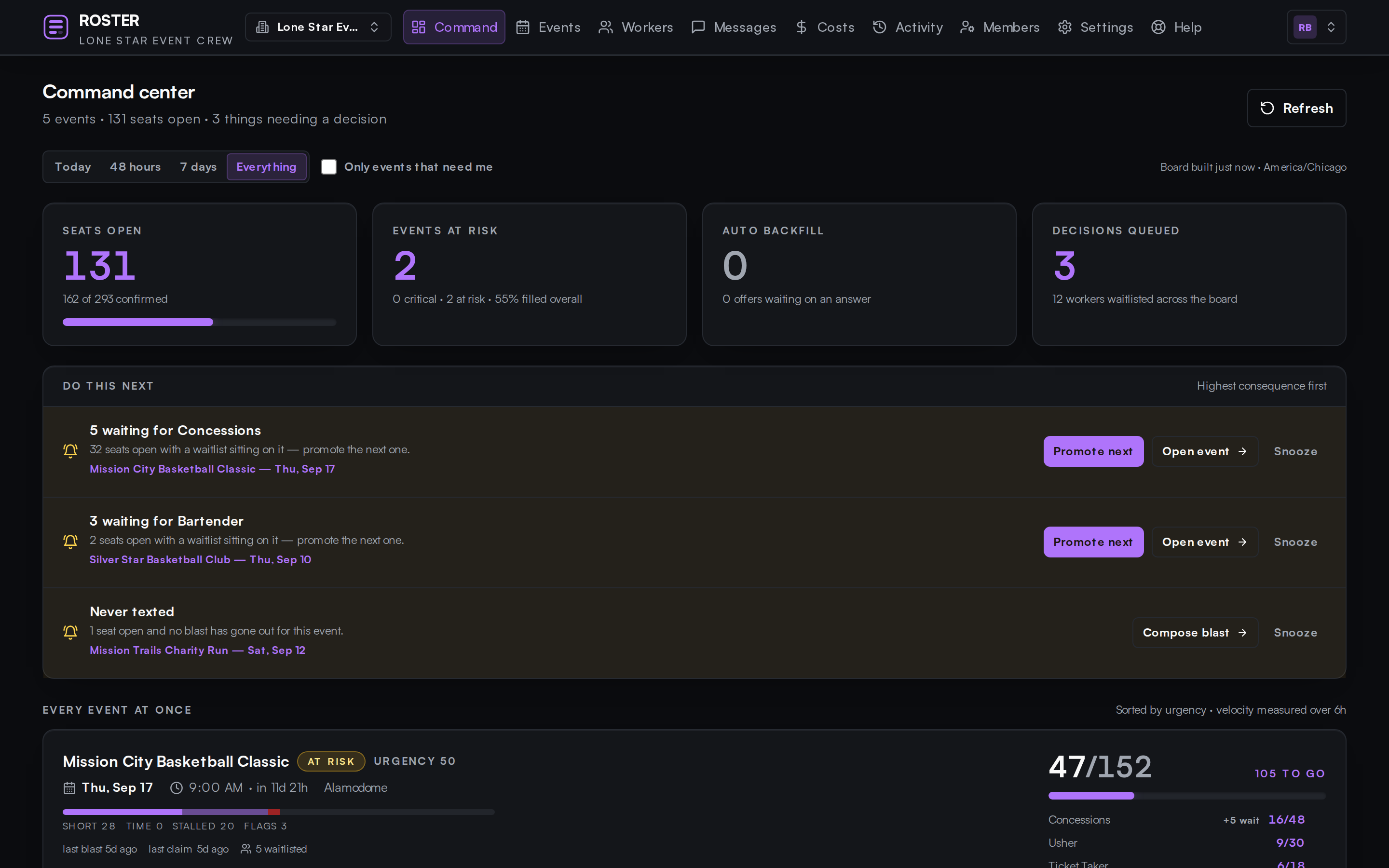
Every open event on one board, sorted by what's most at risk. Seats open, fill pace, and what needs a decision right now — without opening eight events to find out.
A clean roster sheet for the venue, with roles, call times, and phone numbers, ready the morning of.
STOP handling, opt-out state on every worker, and a logged record of who changed what and when.
Claim pages and sign-up forms render in the worker's own language. Half your pool shouldn't have to translate a shift offer to take it.
Workers open a link and tap. Coordinators work from a phone, iPad, or laptop — same board, same numbers.
The text bill
Roster connects to your own carrier account, so you pay wholesale per message instead of per-credit retail. We take nothing on top.
Buying texting credits
$43.20
one event — 120 people, 4 messages each
480 credits × 9¢ at that volume
= $43.20
1 credit = 1 message to 1 recipient
Roster on your own carrier account
$4.08
one event — 120 people, 4 messages each
480 segments × $0.0085 all-in
= $4.08
$0.004 carrier + ~$0.0045 pass-through fee
Credit math uses the published 9¢ rate for the 400–999 credit band, where one credit is one 160-character message per recipient (Text-Em-All pricing). Carrier math uses $0.004 per message part plus per-carrier fees of roughly $0.0035–$0.005 (Telnyx messaging pricing). Sending from your own number also means one-time 10DLC registration — $4.50 brand, $15 per campaign review, and $1.50–$10 a month depending on throughput (Telnyx 10DLC fees). Straight talk: if you're on a flat monthly texting plan instead — $69/month for 101–200 unique numbers with no message cap (same page) — your text savings will be small, and the money is in the software line instead. Bring one invoice to the walkthrough and we'll do your real math out loud.
Pricing
Grow your pool from 120 to 500 and your bill doesn't move. Messages go straight to your carrier at cost.
One coordinator, a few events a week, a pool you know by name.
$99/mo
2 office users · unlimited workers
Most agencies
Several events on the same weekend and a pool too big to text by hand.
$249/mo
6 office users · unlimited workers
Multiple brands or branches, several coordinators, thousands on the roster.
$499/mo
Unlimited office users · unlimited workers
What the same 500-worker pool costs elsewhere, per month
Per-user vendors count every account. 505 seats × their published per-user rate — Connecteam $49 base + 475 × $2.50 annual, When I Work 505 × $2.50, Deputy 505 × $6.50, where Deputy states "all users, administrators, supervisors are considered users." The two platforms actually built for event labor publish no price at all (Nowsta, Shiftboard). Prices read September 2026.
Add-on
Unlimited sign-up links, markets, and per-link source reporting added to a Crew plan. If you need all three every month, Agency at $499 is the better buy — we’ll tell you so.
Straight answers
No. They get a text with a short link, open it, and tap the role they want. No download, no account, no password.
Claims are locked at the database level, one seat at a time. In testing, twenty people tapping at once for five seats produced exactly five confirmations and zero overbookings.
Yours. You connect your own carrier account and register your own 10DLC brand, so replies come back to a number your workers recognize and the sender reputation belongs to you.
Yes. Bring a spreadsheet of names, numbers, and roles and it imports directly. Export is always available too — the list is yours.
No, and it doesn't try to. Roster fills shifts and tracks who committed. Clock-in and payroll stay wherever they are today.
The board itself is ready the day you import your pool. Texting on your own number waits on carrier registration, which typically takes a few business days.
Twenty minutes. Bring one upcoming order and one text invoice, and we'll build it live on the board and price the difference.